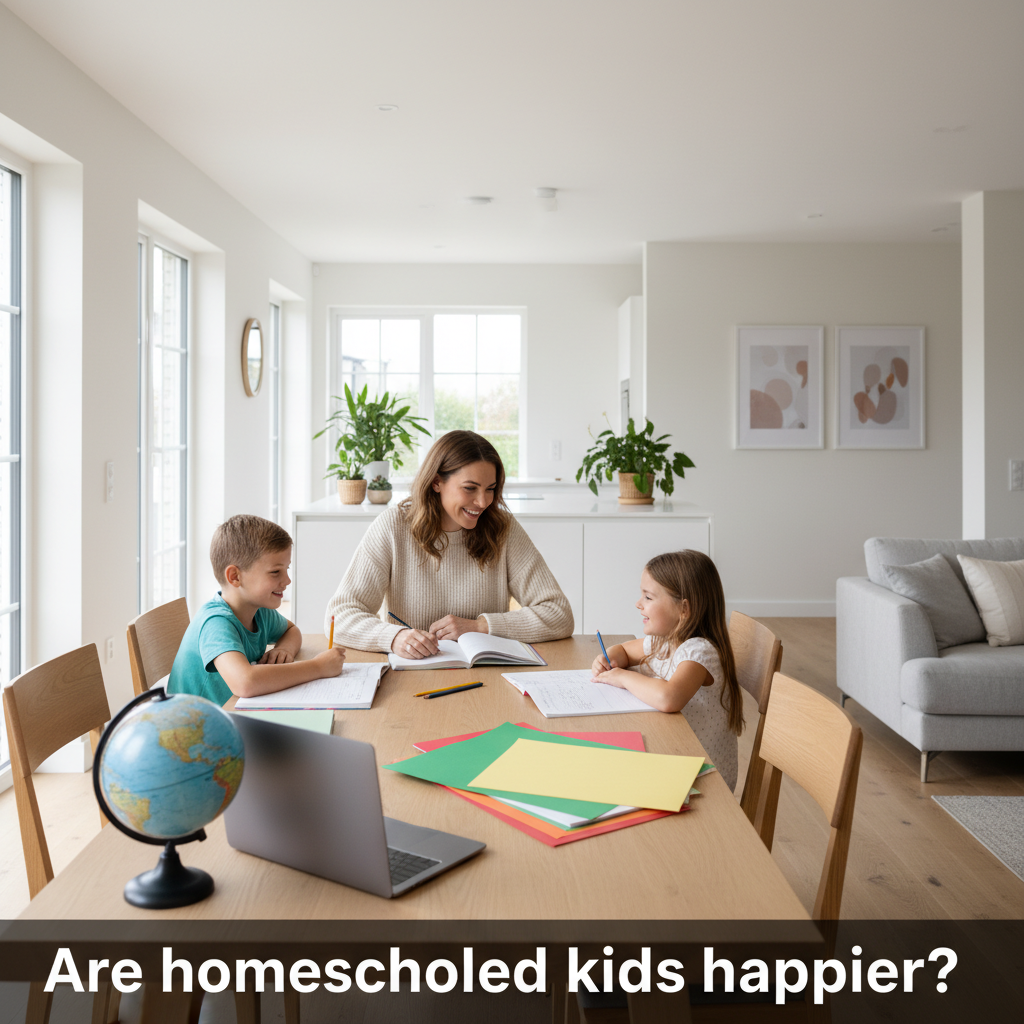
Look, I never thought I’d be that mom. You know the one—Pinterest boards full of educational activities, teaching my own kids at home, making breakfast while simultaneously explaining fractions. But here I am, three years into homeschooling Jared, with baby Maddie crawling around our “classroom” (aka the kitchen table), and I gotta tell you something.
My kid is happy. Like, genuinely, belly-laugh, can’t-wait-to-start-the-day happy.
And that got me thinking—was this just a fluke, or are homeschooled kids actually happier? So I did what any anxious mom does at 11 PM—I fell down an internet research hole. What I found honestly shocked me.
Turns Out, I Wasn’t Crazy
So apparently there’s actual research on this stuff. Multiple studies show homeschooled kids score higher on happiness and life satisfaction than kids in regular school. The National Home Education Research Institute did this big study and found homeschooled kids have better emotional well-being.
But get this—it’s not because they’re getting straight A’s (though many do). It’s deeper than that.
No More Morning Hell
Can we just talk about mornings for a hot second? Remember those days? Dragging your kid out of bed at 6:30, shoving cereal in their face, fighting about everything from shoes to backpacks while racing against the clock?
Yeah, we don’t do that anymore.
Jared used to be a complete zombie in the morning. Getting him ready for school was like trying to dress a wet cat. Now he wanders down whenever he wakes up, grabs some toast, and we start learning when we’re both ready. Sometimes that’s 8 AM, sometimes it’s 10. The world hasn’t ended.
Last month he was really struggling with long division. Every morning at 9 AM sharp, tears. So you know what we did? We moved math to 2 PM. Problem solved. Suddenly division clicked because his brain was actually awake.
Try doing that in a regular classroom where math happens at 9:15 whether your brain is ready or not.
And when Jared got obsessed with space for two months straight? We leaned into it. NASA websites, documentaries, we even drove to the planetarium three times. In regular school, he would’ve gotten exactly two weeks of space unit in science class, then moved on to rocks whether he was ready or not.
We Actually Talk to Each Other Now
This sounds weird, but homeschooling saved my relationship with my son. Before, our conversations were all about homework and hurrying up. Now we actually talk about stuff that matters.
Like yesterday, Jared asked me why people fought in the Civil War while we were making lunch. So we talked about it. For an hour. While making sandwiches and feeding Maddie. No worksheets, no tests, just a real conversation about something he was genuinely curious about.
I know how his brain works now. He’s a pacer—he thinks better when he’s moving around. So we do “math walks” around the block. He understands history when we act it out (you should see our dramatic reenactments of the Boston Tea Party).
And Maddie? She’s part of everything. She claps when Jared gets excited about something. She’s already learning just by watching us learn together. It’s pretty cool.
Research backs this up too, but honestly, I don’t need studies to tell me our family is closer. I can see it every day.
“But What About Friends?”
Oh man, the socialization question. I swear, if I had a dollar for every time someone asked me this…
Here’s the thing—Jared has MORE friends now, not fewer. His week looks like this:
- Soccer with kids from five different schools
- Art class at the rec center
- Story time at the library where he reads to little kids
- Park meetups with our homeschool crew
- Helping at the animal shelter
The difference? These friendships are real. He’s not sitting in rows being shushed all day. He’s actually talking to people, working on projects, having real conversations.
His best friend is Tommy from down the street who’s two years younger. They spend hours building elaborate Lego cities and discussing “engineering problems” (their words, not mine). You don’t get that kind of friendship in age-segregated classrooms.
Plus, he talks to adults like they’re actual people now, not authority figures to be feared. It’s pretty amazing to watch.
His Confidence Is Through the Roof
This was the biggest surprise. Jared used to be so worried about being wrong in front of other kids. Now? He takes risks, asks questions, makes mistakes, and just keeps going.
In regular school, learning happens on stage. You’re right or wrong in front of 25 other kids. You keep up or you don’t, publicly. That’s a lot of pressure for an 8-year-old.
At home, if he doesn’t get something the first time, we try again. No audience, no judgment. Learning is about understanding, not performing.
We’ve found some resources that really work for us. The Well-Trained Mind gave us a roadmap when I felt totally lost. For math, Saxon Math builds concepts slowly—perfect for building confidence without overwhelming. And Apologia Science makes science feel like adventures instead of boring textbook stuff.
The Stuff Nobody Tells You
Alright, real talk time. This isn’t all Pinterest-perfect learning moments and happy kids skipping through meadows.
Some days I’m exhausted. Teaching while keeping a toddler from eating crayons is no joke. There are days I lock myself in the bathroom and wonder if I’m completely ruining my kid’s future.
Money’s tight. We went from two incomes to one, and curriculum adds up fast. I’ve become a master at finding free stuff—library programs, online resources, hand-me-down books from other homeschool families.
And can we talk about being lonely? I miss having work friends. I miss conversations that don’t involve explaining why we can’t eat Play-Doh. Thank God for our homeschool group—those parents have become my lifeline.
On my worst days, I rely heavily on good organizational systems and backup activities when my brain just can’t come up with one more creative lesson.
What Actually Makes It Work
After three years and talking to tons of other homeschool families, here’s what I think makes the difference:
You gotta be in it for the right reasons. Not just running away from bad schools, but running toward something better for your specific kid.
Structure helps, but it doesn’t have to be rigid. We have routines—Jared knows what to expect—but if something isn’t working, we change it.
Community is everything. Find your people. It took me a year to find families we clicked with, but it was worth the search.
And honestly? Don’t cheap out on resources if you can help it. You don’t need to spend a fortune, but having quality materials that match your kid’s learning style makes a huge difference.
Thinking About Maddie
Watching Maddie grow up in this environment has me excited about her future. She’s already showing she’s completely different from Jared—more social, more verbal, way more dramatic. The cool thing about homeschooling is we can figure out what works for HER from the start.
She won’t have to unlearn the idea that learning is something that happens TO you instead of something you DO. She won’t lose that natural curiosity all toddlers have. At least, that’s the plan.
So Are They Happier? My Honest Answer
In our case? Absolutely yes.
Jared wakes up excited about his day. He asks to keep working on projects after “school time” is over. He tells dad about what he learned over dinner. He’s not stressed about tests or friend drama or whether he fits in.
But here’s the catch—this works for us because we made it work. We committed fully, found our community, invested in good resources, and stayed flexible when things weren’t working.
Would this work for every family? Definitely not. Some kids thrive in traditional schools. Some parents aren’t cut out for this (and that’s totally okay). Some families can’t make the financial sacrifice.
But if you’re wondering whether it’s possible to have happy, well-educated, socially connected homeschooled kids? The answer is yes.
Questions I Wish Someone Had Asked Me
If you’re thinking about this, here’s what I wish someone had made me consider:
Can you handle being around your kids 24/7? (Some days the answer is still no, and that’s normal.)
Are you willing to completely change how you think about education?
Can your family handle living on less money?
Are you ready for people to question your choices constantly?
Do you have any support system at all?
My Bottom Line
Four years ago, if you’d told me I’d be homeschooling and blogging about it, I would’ve laughed in your face. But here we are.
Is Jared happier? Without question. Is our family closer? Absolutely. Is it hard sometimes? Every single day.
But watching your kid fall back in love with learning? Seeing them build real confidence instead of just good grades? Having actual conversations instead of homework battles?
Yeah, it’s worth it.
As I watch Maddie babble at her books and try to “help” with Jared’s math, I’m pretty sure we’ll go down this road with her too. Because we get one shot at their childhood. If we can make it happier and more authentic to who they are, why wouldn’t we try?
What about you? Are you considering homeschooling, or have you found happiness in traditional school? I’d love to hear your story—parenting is hard enough without doing it alone.
About me: Just another mom figuring it out one day at a time. I write about our real experiences—the messy, imperfect, sometimes magical journey of raising kids at home.
Quick heads up: Some links in this post are affiliate links to stuff we actually use. If you buy something, I might make a few bucks to keep this blog going, but it doesn’t cost you extra.