What are the best mom hacks for surviving busy mornings?
Mornings are where the chaos lives. The lost shoe. The forgotten permission slip. The kid who suddenly hates every item of clothing they own. The good news? Most morning stress is actually created the night before — which means it can be fixed the night before too.
The night-before reset
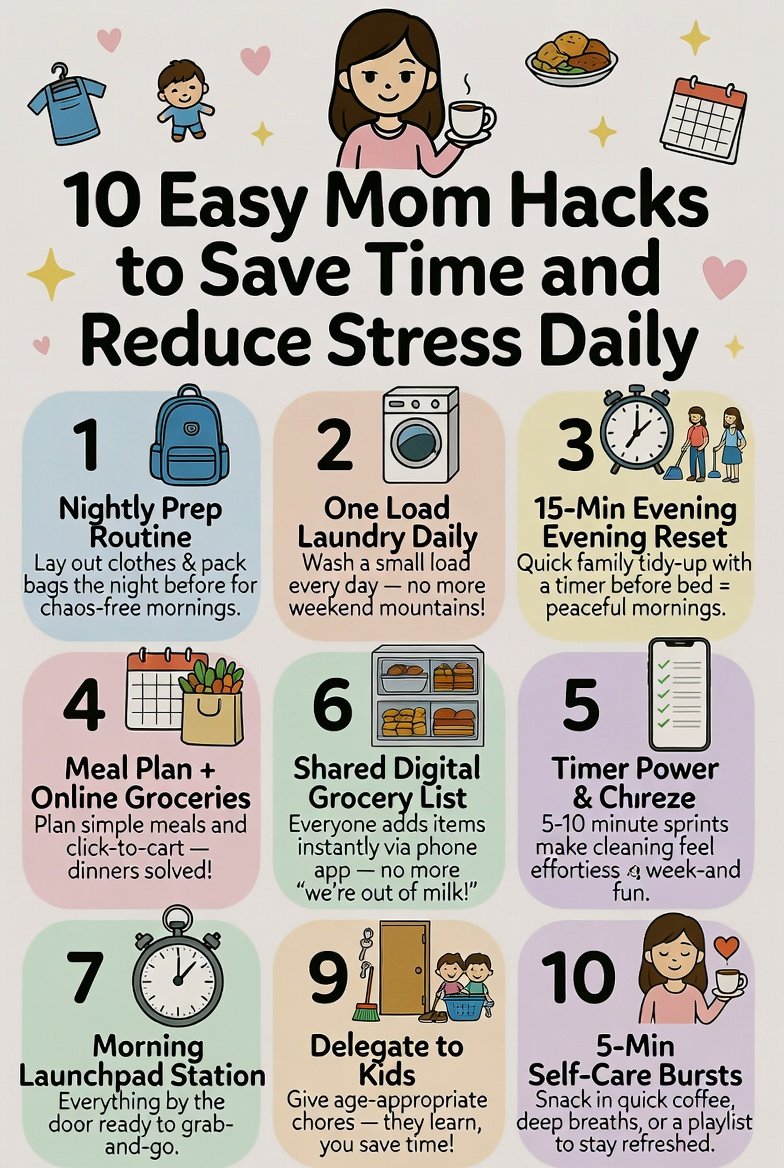
This is the single highest-impact habit you can build. Before you go to bed, spend 10–15 minutes doing the following: lay out tomorrow’s outfits (yes, yours too), pack the backpacks, prep any lunches you can, and put everything by the door. That’s it.
Sound familiar to what your mom used to tell you? There’s a reason. Research on family routines consistently shows that a little preparation the night before can cut your morning rush time nearly in half. Half. When you’re not scrambling at 7am trying to find matching socks, you get to actually be present with your kids before they head out the door. That’s the part worth protecting.
If your kids are old enough, involve them in choosing their outfits the night before — it saves negotiation time in the morning and gives them a sense of ownership. Check out our guide to 5-minute morning routines for moms for even more ways to start the day calm.
The 10-minute family tidy timer
Here’s a hack that sounds almost too simple: set a timer for 10 minutes every evening before wind-down, and everyone tidies their own area. No marathon cleaning sessions, no resentment, no one person doing it all.
I tried this after months of spending my Saturday mornings deep-cleaning the whole house. Once I switched to a daily 10-minute reset — counters wiped, dishes done, one load of laundry — the house was never perfect, but it was always livable. And I got my Saturdays back. The key is the timer. Something about that countdown makes it feel doable instead of endless.
How can meal planning actually save a busy mom time?
The “what’s for dinner” question is one of the biggest daily mental drains for moms. Productivity experts note that eliminating daily decision-making around food is one of the fastest ways to reduce mental load. The goal isn’t elaborate meal prep — it’s removing the decision entirely.
The Sunday prep window
Designate one block of time on Sunday — even just 90 minutes — for batch prepping the basics. Chop vegetables. Cook a big batch of grains. Marinate proteins. You’re not cooking full meals; you’re just doing the boring parts in advance so weeknight cooking takes 20 minutes instead of 45.
I spent two hours one Sunday prepping dinners for the week. By Wednesday I realized I’d saved at least six hours of weeknight cooking stress AND we ate out zero times. The time investment pays for itself immediately.
The designated dinner night system
Taco Tuesday isn’t just a fun alliteration — it’s a legitimate time-saver. When certain nights have a designated theme (pasta night, leftovers night, slow cooker night), you eliminate that daily decision entirely. Family routine experts recommend building these themed nights into your weekly rhythm so dinner becomes automatic rather than another thing to figure out.
Your family will also start to love the predictability — kids especially thrive on knowing what to expect. Check out our easy family meal prep guide for a full breakdown of how to set this up in under an hour.
Grocery delivery — the 53-hour-a-year hack
Here’s a number that stopped me cold: according to the Time Use Institute, the average grocery trip takes 41 minutes. At 1.5 trips per week, that adds up to more than 53 hours a year spent in grocery store aisles. That’s more than two full days of your life, every single year, just shopping for food.
Grocery delivery or curbside pickup doesn’t have to be a luxury. Most major retailers offer it for free above a minimum order, or for a small annual fee. If it saves you 53 hours, do the math on what that’s worth to you.
Smart home organization hacks that basically run themselves
The best home systems are the ones you don’t have to think about. Once they’re set up, they just work — which means you stop spending mental energy managing them.
The snack station
Create a dedicated snack bin in the fridge (and one in the pantry) that kids can access completely on their own. Stock it with grab-and-go options: cut fruit, cheese sticks, individual portions of crackers, pouches. Label it clearly. Then step back.
Once I set this up, about 40% of my kitchen interruptions during the day disappeared overnight. Kids stopped asking me for snacks every 45 minutes because they could help themselves. It sounds tiny, but when you add up the number of times a day you’re redirected from whatever you’re doing, it’s genuinely significant.
The family command center
One central spot in your home — a wall near the door, a corner of the kitchen — where everything lives: the family calendar, a whiteboard, a key hook, a charging station, the permission slip pile. A shared digital calendar like Google Calendar or Cozi paired with a physical hub eliminates the “where’s my…” scramble that eats up so many minutes every day.
The key is that everyone uses it. It only works if the whole family knows this is the spot. Pair it with our tips on home organization for moms to set it up in a weekend.
One load of laundry a day
Laundry is every mom’s Goliath. It piles up fast and looms large. But here’s the reframe: one load a day — wash in the morning, fold in the evening — means you never face a mountain on the weekend. Most modern washing machines have delay settings, so you can throw a load in before bed and wake up to a finished cycle. By Friday, laundry is simply done. No backlog. No dreaded laundry day.
How do you reduce the mental load as a mom?
The mental load — all that invisible planning and remembering — is the part that truly exhausts moms. It’s not just doing the tasks; it’s holding them all in your head simultaneously. Two hacks make a real dent here.
Time-blocking your day into chunks
Time-blocking means assigning specific chunks of your day to specific types of tasks, rather than bouncing between everything all at once. Work emails in the morning. Errands after school pickup. Household admin during nap time. When you know what each block of time is for, you stop the constant context-switching that drains mental energy so fast.
You don’t need a color-coded planner to do this. Start with three blocks: morning, midday, evening. Assign two or three priorities to each. See our full guide to creating a family schedule that actually works for a practical template.
Errand batching
Instead of running one errand here, one errand there throughout the week, designate one day as your errand day and knock them all out together. Pharmacy, dry cleaning, bank, grocery pickup — done in one loop, one time. Your brain processes better when similar tasks are grouped, and you’ll spend dramatically less time in your car.
This one hack alone recovered almost a full afternoon for me every week. If you’re managing near mom burnout from the constant running around, our guide to recognizing and recovering from mom burnout is worth a read too.
Mom hacks for getting kids to actually help
You don’t have to do all of this alone. You really don’t. Getting kids involved isn’t just about lightening your load — research shows that children who do regular chores develop stronger self-esteem, responsibility, and life skills. It’s genuinely good for them. So stop feeling guilty about asking.
Age-appropriate chores that stick
Toddlers can put toys in bins and wipe surfaces with a damp cloth. Kids ages 4–6 can set the table, feed pets, and water plants. By 8 or 9, they can fold laundry, load the dishwasher, and help with meal prep. Teenagers can handle almost anything — their own laundry, cooking simple meals, vacuuming, yard work. Start earlier than you think you should, keep expectations age-appropriate, and don’t redo their work. Imperfect and done beats perfect and never started.
The trick that makes chores stick? A timer and music. Set 15 minutes, pick a fun playlist, and everyone picks an area. Family routine experts recommend making the experience lighthearted rather than punitive — and it works.
The phone-free hour that gives you back your brain
This one isn’t about the kids — it’s about you. Try putting your phone in a drawer for one hour in the afternoon. Just one hour. No notifications, no scrolling, no half-present parenting.
I started doing this from 4–5pm while the kids were doing homework. The difference in my stress levels was immediate. I wasn’t half-present; I was actually there. The kids noticed. The conversation was different. And genuinely, the rest of the evening felt calmer because I hadn’t spent that hour fragmented. This is the kind of self-care for moms that costs nothing and pays back double.
You don’t need a perfect system. You just need to start.
Here’s what all 10 of these mom hacks have in common: they’re small. None of them require a Pinterest-worthy organization system, a new app, or a complete schedule overhaul. They’re tiny shifts — a timer here, a snack bin there, one less grocery trip per week — that quietly compound into hours of time and truckloads of stress that you’re no longer carrying.
Pick one this week. Just one. See how it feels. Then come back and grab another.
You’ve got this. And you deserve a little more breathing room in this beautiful, chaotic, incredibly full life you’re running.