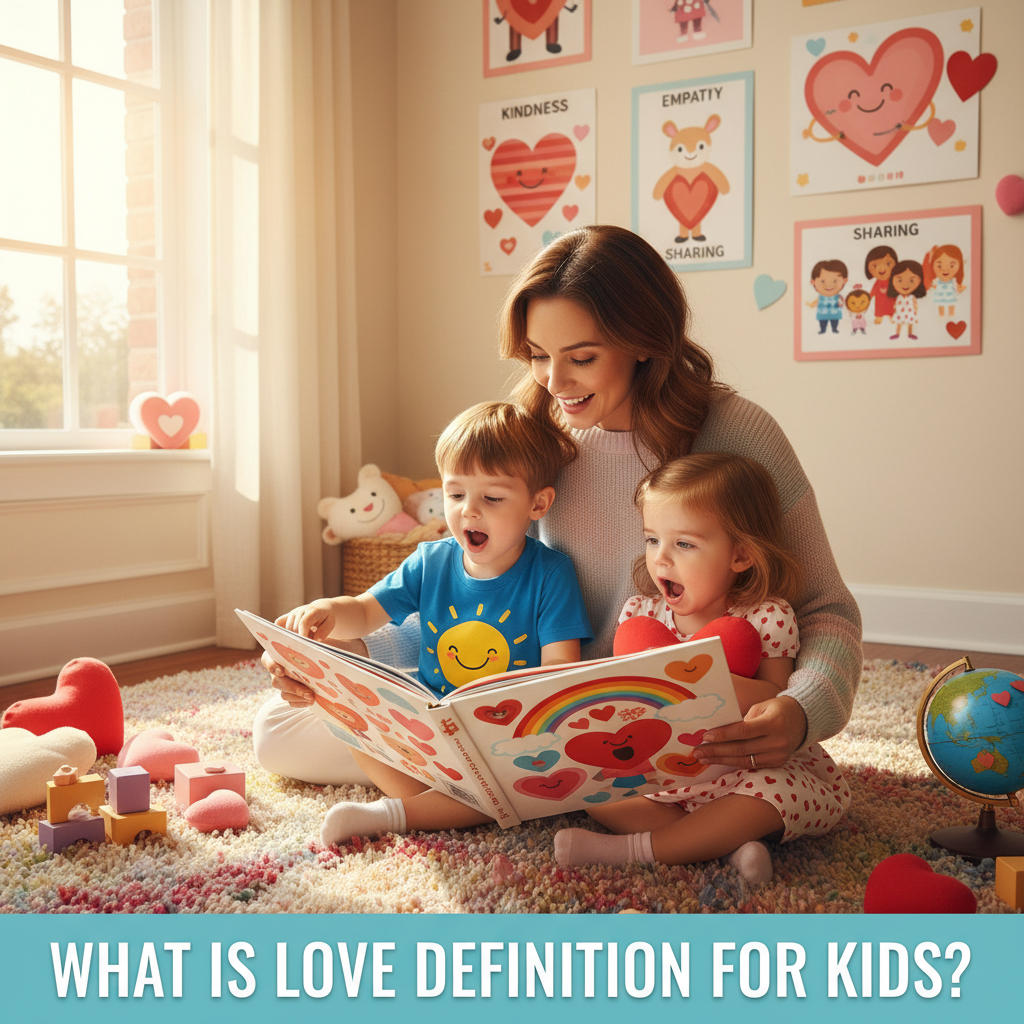
What is Love? A Simple Definition for Kids That Every Parent Should Know
So there I was, exhausted on a Tuesday night, trying to get baby Maddie to finish her bottle when my 8-year-old Jared suddenly plops down next to me on the couch. No warning, no context, just: “Mom, what IS love, exactly?”
I’m pretty sure I made some weird noise – like a mix between a laugh and a groan. Because seriously? Right now? When I’m running on three hours of sleep and there’s dried spit-up on my shirt?
But you know what? Kids don’t care about timing. They ask the big questions when they ask them, and apparently Tuesday night bottle-feeding time was when Jared needed to figure out one of life’s biggest mysteries.
I fumbled through some answer that night – something about caring for people and feeling happy when they’re happy. Not terrible, but not great either. That conversation has been bugging me for weeks now, so I’ve been doing some serious thinking (and okay, some googling too) about how to actually explain love to kids.
Turns out, it’s both way simpler and way more complicated than I thought.
Kids Already Get Love – They Just Don’t Know It
Here’s what hit me while watching Jared with Maddie yesterday: he totally understands love, he just doesn’t have words for it yet.
Like when Maddie was having one of those epic meltdowns (you know the kind – where nothing works and you start questioning all your life choices), Jared disappeared into his room. I’m thinking great, now I’ve traumatized both kids. But he came back with his most prized possession – this ratty stuffed dinosaur he’s had since he was three – and just gently placed it next to her.
That’s love, right there. He didn’t think about it or analyze it. He just saw someone he cared about in distress and wanted to help.
The thing is, kids live love all day long. They just don’t realize that’s what all these feelings and actions are called. Getting excited when dad comes home from work? Love. Sharing the last cookie? Love. Crying when the dog gets hurt? Also love.
How I Actually Talk About Love (Without Sounding Like a Textbook)
With Little Ones
Maddie’s obviously not asking philosophical questions yet, but when she does, I’m keeping it super basic. No fancy explanations, just:
“Love is when someone takes care of you and makes you feel safe.”
That’s it. Because that’s what love is to a small kid – mom showing up when they cry, dad reading the same book seventeen times, grandma always having snacks ready. They don’t need to understand the psychology behind it.
With Kids Like Jared
Now Jared’s at this age where he wants real answers, not baby talk. So I’ve started explaining it like this:
“Love is when you care about someone so much that making them happy makes YOU happy too. And you’re willing to do hard stuff or give up things you want if it helps them.”
He gets this because he sees it everywhere. When I stay up until midnight helping him with that impossible science project, or when he gives up screen time to help me fold laundry because I’m stressed. It’s not abstract – it’s Tuesday night reality.
The Big Questions That Make Me Sweat
Oh boy, the questions kids ask. Last week Jared hit me with: “Do you love me more than Maddie?”
My heart just about stopped. How do you even answer that? I ended up explaining it like this: “You know how you can be really hungry for pizza AND ice cream at the same time? It’s not like you’re less hungry for one because you want the other too. Love is kind of like that – there’s room for loving different people completely, just in different ways.”
Not perfect, but he seemed to get it.
Then there was: “Why do some parents not love their kids?” This one came after he overheard something on the news. Ugh. How do you explain that some adults are so broken they can’t love properly without terrifying your kid?
I went with honesty but kept it simple: “Some grown-ups got hurt so badly when they were little that they forgot how to love the right way. That’s really sad, but it’s not normal, and it’s definitely not your fault when it happens.”
Heavy stuff, but kids hear things anyway. Better they hear it from me with context than piece together scary fragments on their own.
The Different Types of Love (That Actually Make Sense to Kids)
Family Love – The Safe Zone
This is home base love. I tell Jared it’s like his security blanket – always there, even when it’s in the wash. Family love means:
- Someone’s always in your corner
- You can mess up and still belong
- People show up when you really need them
- You don’t have to earn it
When Jared spent twenty minutes yesterday patiently trying to make Maddie laugh with silly faces, even though she kept ignoring him for her own feet instead – that’s family love. Persistent, a little ridiculous, and totally unconditional.
Friend Love – The Choice Kind
This is different from family love because you actually choose it. Jared has this friend Marcus who he met in kindergarten, and watching them together is like seeing love in its purest form. They:
- Actually WANT to spend time together
- Share stuff without being told to
- Stick up for each other
- Work through fights because the friendship matters
When Marcus broke his arm last month, Jared drew him a comic book about a superhero with a cast. Nobody told him to do that. He just wanted his friend to feel better. That’s friend love.
Loving Yourself – The Tricky One
Not gonna lie, this one’s hard to teach because I’m still figuring it out myself. How do you teach a kid to love themselves without creating a little narcissist?
I try to show Jared that loving yourself means:
- Being patient with yourself when you mess up (still working on this one)
- Taking care of your body and feelings
- Being proud of effort, not just results
- Knowing you’re worthy of good things
But honestly? He learns this more from watching how I treat myself than from anything I say. When I call myself stupid for forgetting something, he notices. When I skip meals because I’m too busy, he sees that too. Teaching self-love means I have to practice it, and some days I totally fail at that.
Love for Everyone Else
This is the big picture stuff – caring about people you don’t even know, being kind to animals, helping when you see someone struggling.
Jared’s naturally empathetic (thank goodness), but I try to nurture this by letting him help when we donate clothes, talking about why we’re kind to people who are different from us, and reading books about kids from other places.
Last month we were at the grocery store and saw this elderly man struggling with his bags. Jared immediately asked if we could help. The man was so surprised and grateful – apparently not many people stop to help anymore. That moment taught Jared more about love than any speech I could give.
How This Actually Plays Out in Real Life
I Show It More Than I Say It
Kids are basically little detectives – they notice everything we do and file it away. So instead of just talking about love, I try to live it where Jared can see it.
When Maddie’s sick and I’m up with her all night, Jared sees that. When I help our neighbor Mrs. Peterson with her groceries every week, he notices. When his dad and I work through a disagreement respectfully instead of yelling, he’s taking notes.
Sometimes I literally narrate what I’m doing: “I’m making your favorite pancakes because I love you and want to start your day with something special.” It feels weird saying it out loud, but it helps him connect the action to the feeling.
We Talk About Real Examples
Abstract ideas are impossible for kids. But real examples? Those stick. So when Jared asks about love, I point to specific things:
“Remember when you fell off your scooter last month and Dad was in the middle of an important work call? He hung up immediately and ran outside to help you. That’s love – dropping what you’re doing when someone you care about needs you.”
“Yesterday when Maddie was crying and nothing was working, you brought her your favorite stuffy even though you don’t usually like sharing it. That’s love too – giving up something important to you to help someone else feel better.”
Books That Don’t Make Me Want to Hide
Reading together has been huge for these conversations. Some books that have actually helped (and don’t make me cringe):
The Invisible String was a game-changer when Jared was going through a clingy phase and worried about me leaving for work. It explains how love connects people even when they’re apart, and it really helped him understand that love doesn’t disappear just because someone’s not physically there.
Guess How Much I Love You is this sweet story about a parent and child trying to out-love each other. It always leads to Jared and me having our own “guess how much I love you” competitions, which is adorable and also reinforces that love is infinite.
Warning: Love You Forever will absolutely wreck you emotionally. I ugly-cried reading it to Jared the first time. But it beautifully shows how love continues through all stages of life, so it’s worth the emotional damage.
Our Weird Little Love Traditions
We’ve accidentally created some traditions that reinforce love in our family:
- Every night, each person says one thing they love about every other family member (Maddie just gets squished and giggled at)
- Random “I love you” notes in lunch boxes (Jared started doing this for me too, which melts my heart every time)
- Sunday morning group hugs where we all pile on the couch (Maddie thinks this is the best game ever)
- Monthly family service projects (last month we made sandwiches for a homeless shelter)
None of this was planned. It just sort of evolved because we kept looking for ways to show love instead of just talking about it.
The Questions That Keep Me Up at Night
“Will you always love me, even if I do something really, really bad?”
This one came after Jared accidentally broke my grandmother’s vase and was convinced I was going to stop loving him. My heart broke a little.
“Yes, always. I might be disappointed in choices you make sometimes, and there might be consequences, but I will never, ever stop loving you. That’s what family love means – it doesn’t disappear.”
He needed to hear that about fifty more times before he believed it, but now he knows.
“Why doesn’t everyone love each other?”
Oh, this one. It came after he overheard something about a shooting on the news. How do you explain hatred and violence to an 8-year-old who thinks love should be the default?
I went with: “I wish everyone did love each other. Some people never learned how to love properly, or they got so hurt that they forgot. Others choose fear or anger instead of love. That’s why it’s even more important for people like us to choose love whenever we can.”
Not a perfect answer, but it’s honest and it gives him some agency – he can choose to be part of the solution.
Teaching Love Through Actually Doing Stuff
Some of our best conversations about love happen when we’re actively helping people. Jared might only be 8, but he can:
- Help me bake cookies for new neighbors
- Choose toys to donate (this is always hilarious – he gets very serious about which toys would make other kids happiest)
- Draw pictures for the residents at the nursing home down the street
- Be extra kind to classmates who seem lonely
These activities show him that love isn’t just about family – it’s about caring for our whole community. Plus, seeing how happy it makes other people helps him understand that love feels good for everyone involved.
Resources That Actually Help (And Don’t Break the Bank)
More Books That Don’t Suck
For babies and toddlers: Pat the Bunny is perfect for teaching gentle touch and care. Even little ones can learn about loving interactions through simple books like this.
For bigger kids: The Way I Love You shows different ways animals express love. It’s sweet without being sappy, and it leads to great conversations about how people show love differently too.
Tools That Surprisingly Work
I got these Feelings Flash Cards thinking they’d be cheesy, but they’ve actually been great for helping Jared identify and talk about different emotions, including the various flavors of love and affection.
The Social Skills Picture Book has been unexpectedly helpful for navigating friendship issues at school and talking about empathy and caring behaviors.
Creating a Home Where Love Actually Grows
Teaching about love isn’t just conversations – it’s creating an environment where love can flourish naturally. In our house, that means:
Everyone Gets to Have Big Feelings
Nobody has to pretend they’re happy all the time here. When Jared’s frustrated or when I’m having a rough day, we talk about it. Love includes accepting the whole person, not just the shiny parts.
We Notice the Good Stuff
When Jared helps without being asked, I make sure he knows I saw it. When he’s patient with Maddie, we talk about how that patience is a form of love. When I see him being kind to the neighbor’s dog, I point it out.
Mistakes Don’t Equal Disaster
Nobody’s perfect in our house, thank goodness. When I mess up (which is often), I apologize and we move on. When Jared makes poor choices, we talk about doing better next time, but the love doesn’t waver.
Love and Safety – The Non-Negotiable Part
One thing I’m really intentional about teaching Jared: real love always includes safety. Love never:
- Asks you to keep secrets from parents
- Makes you feel scared or uncomfortable
- Involves anyone hurting your body
- Requires you to do things that feel wrong
As he gets older, these conversations will become more detailed and more important. But even now, he needs to understand that love and safety are a package deal.
The Truth About This Whole Love-Teaching Thing
Here’s what nobody tells you about explaining love to kids: you’ll learn as much as they do. Maybe more.
Watching Jared love his baby sister so naturally – with zero self-consciousness or conditions – reminds me what love is supposed to look like. Seeing him genuinely concerned when someone at school is sad, witnessing his immediate forgiveness when I mess up as a parent… these moments teach me about love every single day.
Kids don’t complicate love the way adults do. They don’t overthink it or add conditions or worry about whether they’re doing it right. They just love, simply and completely.
When Jared asks me what love is, I think the real answer is: “You already know. You’re doing it every day.” My job isn’t to teach him how to love – he came equipped with that. My job is to help him recognize the amazing thing he’s already doing and to protect that natural capacity from getting all twisted up by life.
Because here’s what I’ve figured out: love isn’t complicated. We adults are the ones who make it complicated with our baggage and fears and overthinking. Kids understand love instinctively – it’s care, it’s safety, it’s showing up, it’s choosing someone’s happiness alongside your own.
So the next time your kid asks you what love is, remember that they probably already know the answer better than you do. They’re just looking for you to put words to something they feel every time they hug you, every time they share their snacks, every time they comfort someone who’s sad.
And honestly? That might be the most beautiful thing about being a parent – getting to witness pure, uncomplicated love every single day and remembering what we’re all supposed to be aiming for.
What has your kid taught you about love lately? I’d love to hear your stories in the comments – because let’s be real, we’re all just figuring this out as we go.