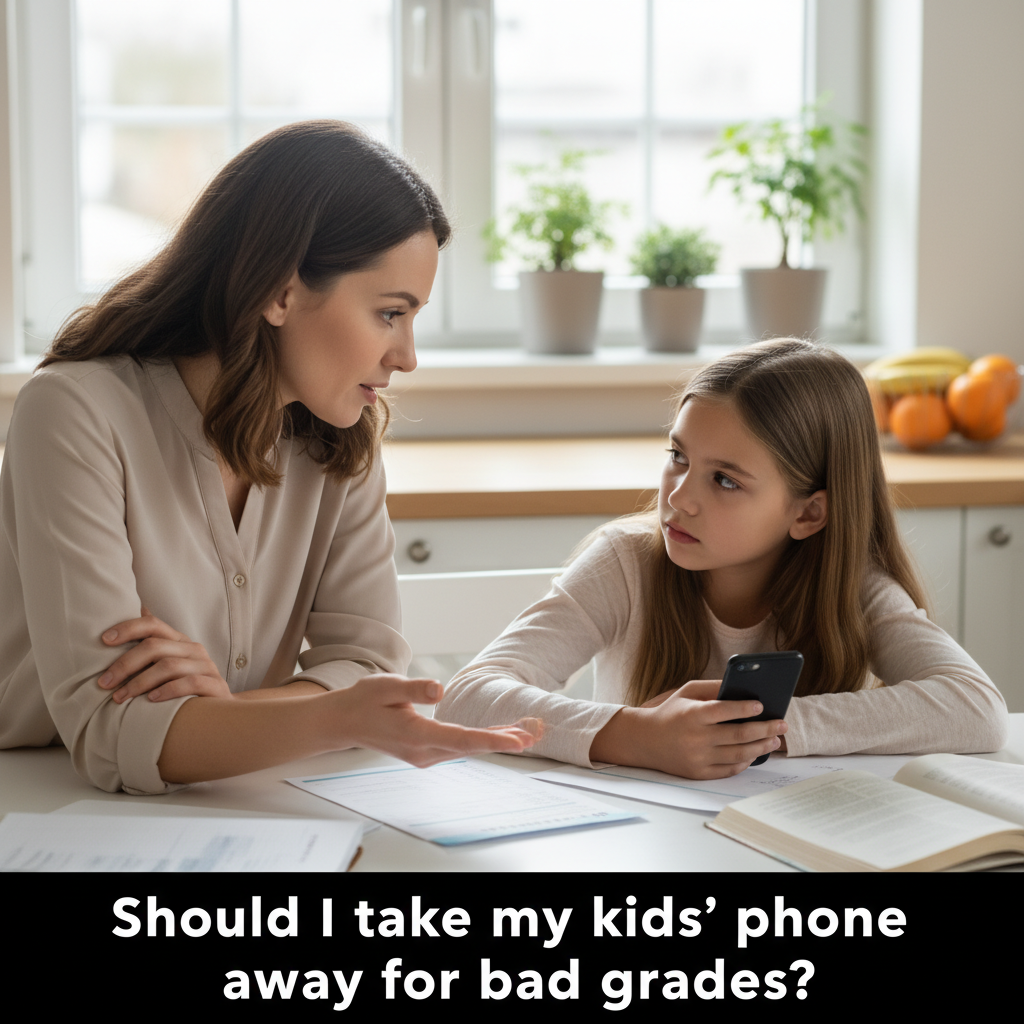
Should I Take My Kids’ Phone Away for Bad Grades?
So my 8-year-old Jared brought home his report card yesterday and… yikes. I’m sitting here with baby Maddie on my lap (she’s teething and basically attached to me 24/7 right now), staring at these grades and wondering where the heck I went wrong.
Math: C-. Science: D+. And before you ask – yes, I immediately wanted to grab his tablet and hide it until he’s 18.
But then I stopped myself because honestly? I’ve tried that before and it was a disaster. Like, epic disaster. The kind where everyone’s crying and nothing gets better.
Why Do We Always Go Straight for the Phone?
Okay can we just be honest here? When our kids mess up, our first instinct is always to take away the thing they love most. And these days, that’s usually their phone or tablet or whatever device they’re obsessed with.
I get it. I really do. You walk into your kid’s room and they’re playing Fortnite instead of doing homework, and your brain immediately goes “AHA! Found the problem!” It feels so simple – no phone, better grades, right?
Wrong. At least in my house.
The Great Tablet Confiscation of Last Month
Let me tell you about the time I completely lost my mind and took away Jared’s tablet for two weeks because he failed a math test.
Picture this: It’s 9 PM on a school night. I’m finally getting Maddie settled down for bed (ha, as if she actually stays asleep), and I ask Jared if he’s ready for his test tomorrow. His face goes white. “What test?”
I practically saw red. This kid had been playing Minecraft for an hour instead of studying for a test he completely forgot about. So I marched into his room, grabbed his tablet, and announced it was gone until his grades improved.
You know what happened? He cried. I felt terrible. And his next test score was exactly the same because – plot twist – taking away his tablet didn’t magically teach him how to remember important dates or study effectively.
Who could have seen that coming? (Insert eye roll here.)
What’s Really Going On Here
After that failed experiment, I actually started paying attention to what was happening with Jared’s homework routine instead of just freaking out about screen time.
Turns out, the tablet wasn’t the problem. The problem was that I’d never taught him how to organize his life. Like, at all.
He’d rush through his math worksheet in five minutes flat – obviously not understanding half of it – just so he could move on to “fun stuff.” Sometimes that was his tablet, sure. But other times it was building with Legos, or playing with our dog, or reading comic books. The rushing was the issue, not what he did afterward.
And here’s the kicker – I’d never actually explained what “studying” means. I just assumed an 8-year-old would figure out that “study for your test” means reviewing notes, practicing problems, maybe asking for help with confusing parts. Nope. To him, it meant looking at his worksheet once and calling it good.
Also, can we talk about how boring his homework is? The kid learns best when he can move around and touch things, but everything is just worksheets. No wonder he was rushing through it to get to more interesting activities.
What Actually Started Working (After Lots of Mistakes)
Instead of being the device police, I decided to try some different stuff. Fair warning – some of this worked, some of it was a complete flop, and I’m still figuring it out.
We Made a Schedule Together
Not like a strict military schedule, but a visual chart showing the flow of our afternoon. Homework time, snack, outdoor play, screen time, dinner, bath, books. He loves checking things off (must get that from his video games), so this actually appeals to him.
I grabbed one of those basic student planners on Amazon – nothing fancy – and we write down what he needs to do each day. Game changer. Seriously.
I Stopped Treating Technology Like the Enemy
This was hard for me because I grew up thinking screens were automatically bad. But here’s the thing – Jared has this math app that makes multiplication practice feel like a game, and he actually gets excited about it. He’s learned more multiplication facts from that app in two weeks than he did from worksheets all semester.
We also found some reading apps that give him points and badges for finishing books. Is it a little silly? Maybe. Does it work? Absolutely.
I Actually Talked to His Teacher
Revolutionary concept, I know. But his teacher gave me some really helpful ideas about how to support his learning at home. She also told me that some of his struggles are totally normal for boys his age, which made me feel less like a failing parent.
Plus, now we’re on the same team instead of me just guessing what I should be doing.
Clear Rules, Not Punishments
We have a simple rule now: responsibilities first, fun stuff second. Homework gets done properly before any recreational screen time happens. But it’s not like he’s being punished – it’s just how our house works.
During homework time, educational apps are totally fine. Games and YouTube wait until after everything’s done.
When Taking the Phone Makes Sense
Look, I’m not saying we should never limit screen time. Sometimes it really is necessary.
If your kid is staying up all night on their phone and then falling asleep in class, that’s a real problem that’s directly affecting their school performance.
Or if they genuinely can’t stop using devices – like they’re trying to do homework but keep getting sucked back to their phone every two minutes – that might need some professional help.
But bad grades by themselves don’t automatically mean too much screen time is the problem.
My Biggest Mistakes (Learn From My Pain)
I tried the nuclear option once – all screens banned for a week after a particularly bad test grade. Everyone was miserable, I felt like a prison warden, and absolutely nothing improved because I hadn’t addressed the real issues.
I also went through this phase where I was tracking his screen time with apps and setting all these timers and restrictions. Our house turned into a battleground where I was constantly monitoring and he was constantly trying to sneak extra time. Not fun.
The biggest mistake was assuming that struggling grades automatically meant too much screen time, when really Jared needed help with basic life skills like organization, time management, and knowing when to ask for help.
What I’m Trying to Teach Him Now
Instead of just controlling his device use, I’m trying to help him think about his own habits. We talk about how different activities make him feel. Is he using his tablet because he’s bored? Because he’s avoiding something hard? Or because he’s genuinely enjoying it?
I’m also finally teaching him study skills that I probably should have started years ago. How to review for a test. How to break big projects into smaller pieces. How to organize his backpack so important papers don’t disappear into the void.
You know, basic life skills that somehow I forgot to teach because I was too busy worrying about screen time.
The Bottom Line
Here’s what I’ve learned after months of trial and error: taking away phones for bad grades usually doesn’t work because it’s treating the symptom, not the problem.
Most kids aren’t struggling in school because they have too much screen time. They’re struggling because they need better organizational skills, or help understanding the material, or different teaching methods, or just someone to show them how to study effectively.
I’m not saying screens can never be a problem – they definitely can be. But maybe instead of immediately going to “take away the phone,” we should ask “what does my kid actually need help with?”
Every kid is different. What’s working for Jared might be a disaster for your family. And what works now might not work next month because kids change and grow and suddenly need different approaches.
The point is, we don’t have to be the technology police. We can help our kids learn to manage technology alongside everything else in their lives.
And honestly? Sometimes that means admitting we don’t have all the answers and figuring it out together. Which is pretty much parenting summed up in one sentence.
I’m still making mistakes daily. Yesterday I completely forgot about Jared’s library book project until he mentioned it at bedtime (oops). But at least now when I see disappointing grades, I don’t immediately panic and start confiscating devices. I take a breath, try to figure out what’s really going on, and work on solving the actual problem.
That’s progress, right? Right??
Anyway, if you’re dealing with this stuff too, you’re not alone. We’re all just doing our best and hoping our kids turn out okay despite our mistakes. And maybe, if we’re really lucky, they’ll learn some good habits along the way.