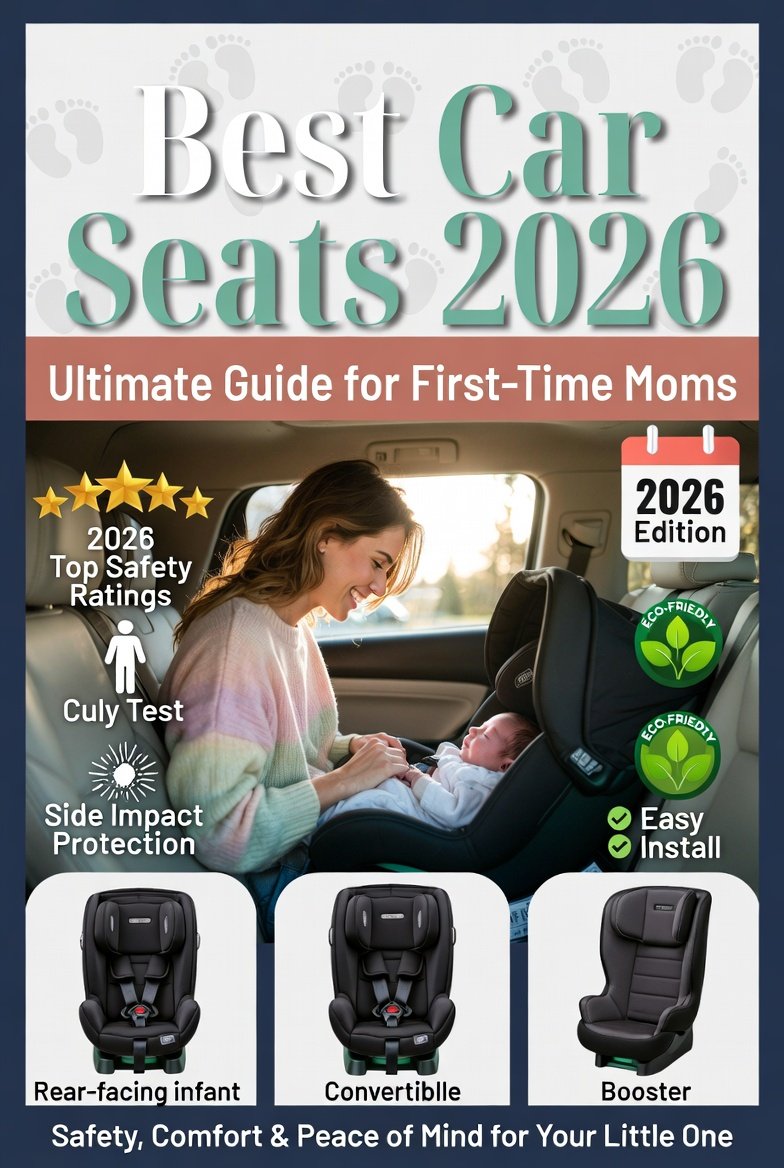
You’ve spent months decorating the nursery, building the crib, and washing every tiny onesie twice. And then someone asks, “So which car seat are you getting?” — and suddenly your brain goes completely blank.
Car seat shopping is genuinely overwhelming. The options are endless, the safety stakes feel impossibly high, and everyone (your mom, your neighbor, that random Facebook group) seems to have a different opinion. Here’s the good news: choosing the right car seat doesn’t have to be a source of anxiety. Once you understand the basic categories and what actually matters for safety, the decision gets a whole lot easier.
This guide breaks down every type of car seat — infant, convertible, all-in-one, and booster — with the best picks of 2026 at every price point, all with Amazon links so you can add them straight to your registry.
What Type of Car Seat Does Your Baby Actually Need?
Before diving into specific models, it helps to understand the four main types of car seats and when each one makes sense.
Infant Car Seats — The First-Year Favorite
Infant car seats are rear-facing only and designed specifically for newborns and smaller babies. They come with a detachable carrier that clicks in and out of a base you leave installed in your car. That click-in, click-out feature is the big selling point — no waking a sleeping baby when you transfer from car to stroller.
Most infant seats accommodate babies from 4 lbs up to 30–35 lbs, which typically covers the first 12–18 months. They’re lighter, easier to carry, and often compatible with travel system strollers, making them a popular first purchase.
The trade-off? Your baby will outgrow one, and then you’ll need to buy a convertible seat anyway.
Convertible Car Seats — The Long-Game Choice
Convertible seats start rear-facing for infants and toddlers, then flip forward-facing once your child outgrows the rear-facing weight or height limit. They don’t have a detachable carrier — the seat stays installed in your car — but they typically last from birth through age 4 or 5 and offer higher weight limits than infant seats.
For families looking to skip the infant seat stage entirely, a convertible seat is a solid option (just know you’ll need an infant insert for a newborn and a way to carry baby separately from your car).
All-in-One Car Seats — Buy It Once, Done
All-in-one seats cover rear-facing, forward-facing, and booster mode in a single seat. They’re marketed as the “last car seat you’ll ever need,” and while that’s not always 100% accurate, they do offer serious longevity — some covering kids up to 120 lbs.
Booster Seats — For the Preschool and Beyond Stage
Once your child outgrows a forward-facing harness (usually around age 4–7 depending on size), a belt-positioning booster seat gets them ready for the regular seat belt. Most kids need a booster until they reach about 4’9″ tall, typically between ages 8–12.
How Long Should My Baby Stay Rear-Facing?
This is probably the most common question first-time moms have, and there’s a definitive answer.
The American Academy of Pediatrics (AAP) recommends that all infants and toddlers ride in a rear-facing car seat for as long as possible, until they reach the highest weight or height allowed by their specific car seat. The key shift in recent guidelines is that there’s no longer a fixed age cutoff — it’s all about the seat’s limits, not a birthday.
Why does it matter so much? Rear-facing distributes crash forces across the entire back, shoulders, and head — the parts of a baby’s body that are both most vulnerable and most supported by a rear-facing seat. According to the AAP, using the right car seat reduces the risk of death or serious injury by up to 71% compared with seat belt use alone.
Don’t worry if your toddler’s feet are touching the back seat. That’s not a safety concern — it just means they’re getting tall, not that it’s time to turn them around.
Best Infant Car Seats of 2026
🥇 Best Overall: Chicco KeyFit 30 ClearTex
The Chicco KeyFit 30 has been the gold standard in infant car seats for years, and the ClearTex version makes it even better. It’s consistently rated the easiest infant seat to install correctly, thanks to a ReclineSure leveling foot and two RideRight bubble level indicators that take the guesswork out of getting the angle right.
The GREENGUARD Gold certification means the fabrics have been tested for low chemical emissions — a big plus for newborns. A one-pull harness tightening system and machine-washable seat pad round out a seat that’s genuinely as easy to live with as it is to install.
- Weight range: 4–30 lbs
- Key features: LATCH + seat belt installation, SuperCinch tightener, EPS foam lining, travel system compatible with Chicco strollers
- Best for: Families who want the easiest installation possible and compatibility with a Chicco stroller system
💰 Best Budget: Graco SnugFit 35 DLX
If you want a trustworthy, highly-rated infant seat without a premium price tag, the Graco SnugFit 35 DLX consistently delivers. It comes with an anti-rebound bar for added rear-facing protection, a no-rethread harness so you don’t have to disassemble the seat every time your baby grows, and SnugLock installation that works with or without LATCH.
It’s also compatible with most Graco strollers, making it a budget-friendly travel system option.
- Weight range: 4–35 lbs
- Key features: Anti-rebound bar, ProtectPlus Engineered safety, no-rethread harness
- Best for: Families watching their budget without sacrificing core safety features
⭐ Best Premium: Nuna PIPA RX
If budget isn’t your primary concern and you want the absolute best crash test performance available, the Nuna PIPA RX is the answer. BabyGearLab calls it their favorite infant car seat of all time after crash testing over 110 seats in a certified lab — specifically praising its best-in-class crash test sensor results.
The PIPA RX also features a load leg (a support that extends to the vehicle floor, dramatically reducing rotation in a crash), MERYL® TENCEL® fabrics free of harmful chemicals, and an incredibly easy installation process. It’s an investment, but for many parents, peace of mind has a price.
- Weight range: 3–32 lbs
- Key features: Load leg, best crash test sensor results, GREENGUARD Gold, flame-retardant-free fabrics
- Best for: Safety-first families who want the best crash test results money can buy
Best Budget-Premium Pick: Britax Willow S
The Britax Willow S is one of those rare finds that punches well above its price point. BabyGearLab found it delivered impressive crash test results and lower sensor G-force readings at a fraction of the cost of many competitors, making it their pick for families on a budget who don’t want to compromise on safety.
It features Britax’s ClickTight belt lock-off for secure installation and an anti-rebound bar — features you’d typically expect to pay significantly more for.
- Weight range: 4–35 lbs
- Key features: Anti-rebound bar, ClickTight installation, impressive crash test results
- Best for: Families who want near-premium safety performance at a mid-range price
Best Convertible Car Seats of 2026
🥇 Best Overall: Graco 4Ever DLX 4-in-1
The Graco 4Ever DLX is the convertible car seat most frequently recommended by both child passenger safety technicians and independent testing labs — and for good reason. BabyGearLab named it their favorite convertible seat after crash testing, praising its excellent crash test analysis, easy installation, and straightforward features.
It converts through four modes (rear-facing infant → forward-facing → high-back booster → backless booster) and has a 10-year expiration, making it genuinely long-lasting. With 10-position headrest adjustment and 6 recline positions, it grows with your child from newborn through the booster years.
- Weight range: 4–120 lbs across all modes
- Key features: 10-year lifespan, 4 conversion modes, non-rethread harness, steel frame
- Best for: Families who want one seat to carry them through multiple stages at a reasonable price
Best Value Convertible: Graco Extend2Fit 3-in-1
If the 4Ever DLX feels like more seat than you need, the Extend2Fit 3-in-1 is a slightly more compact option that delivers similar crash test results at a lower price point. Its extending panel gives rear-facing babies up to 5 inches of extra legroom, which is especially helpful for tall toddlers.
- Weight range: 4–65 lbs (harness), up to 120 lbs (booster)
- Key features: Extending panel for rear-facing legroom, 3-in-1 versatility, ProtectPlus safety engineering
- Best for: Budget-conscious families who still want strong crash test performance
⭐ Best Premium Convertible: Nuna RAVA
The Nuna RAVA is the convertible seat that gets rave reviews for its luxurious feel, non-toxic materials, and incredibly easy installation. Its innovative LATCH door mechanism makes securing the seat nearly foolproof, and the TENCEL® and merino wool fabrics are soft, breathable, and free of harmful chemicals.
It’s not cheap — but reviewers consistently describe the RAVA as “easy” across the board: easy install, easy to clean, easy to use. For families who’ve bought a luxury stroller and want a car seat to match, the RAVA delivers.
- Weight range: 3–65 lbs rear-facing, up to 65 lbs forward-facing
- Key features: LATCH door installation, non-toxic TENCEL® fabrics, extended rear-facing legroom
- Best for: Parents who prioritize materials and luxury build alongside strong safety
🏆 Best for Small Cars / 3-Across: Britax Poplar S
Fitting three car seats across a back row — or fitting any convertible seat in a smaller vehicle — is a real challenge. The Britax Poplar S is designed with a narrower profile and Britax’s ClickTight installation system, which makes it one of the easier seats to get a tight, secure fit in tighter spaces. Child passenger safety technicians frequently recommend it for exactly this reason.
- Weight range: 5–55 lbs rear-facing, up to 65 lbs forward-facing
- Key features: ClickTight installation, narrow profile, multiple layers of side-impact protection
- Best for: Families with smaller vehicles or multiple car seats in a row
Does a More Expensive Car Seat Mean a Safer Car Seat?
Not necessarily — and this is one of the most important things to understand before you buy.
All car seats sold in the U.S. must meet federal safety standards set by the NHTSA. A seat that costs $150 has passed the same basic safety tests as one that costs $600. What you’re often paying more for at the higher price points are premium fabrics (TENCEL®, merino wool, GREENGUARD Gold certification), more convenient features (rotating bases, one-hand adjustments, easier cleaning), and sometimes — but not always — better performance in independent crash testing beyond federal minimums.
The Britax Willow S is a perfect example of this: it costs significantly less than most premium seats and still outperformed many expensive competitors in independent crash testing.
The bottom line? Focus on finding a seat that fits your child’s current size, installs correctly in your vehicle, and that you’ll actually use consistently. The best car seat is always the one installed correctly every single time.
Is My Car Seat Installed Correctly?
Research suggests that up to three out of four car seats are misused in some way — which means getting installation right is just as important as which seat you choose.
Here are the most common installation mistakes to watch for:
The 1-inch rule. A properly installed car seat should move less than 1 inch side to side or front to back when you grab it at the belt path and give it a firm shake. If it’s wobbling more than that, it needs to be tighter.
The harness pinch test. After buckling your baby in, pinch the harness strap at the shoulder. If you can pinch any webbing between your fingers, the harness is too loose.
Chest clip placement. The chest clip should sit at armpit level — not at the belly, which can cause abdominal injury in a crash.
The coat problem. Puffy winter coats under a harness are a major safety issue. The harness needs to be snug against your baby’s body. Put the coat on backward over a buckled-in baby, or use a car seat poncho instead.
If you want peace of mind, look up a Certified Child Passenger Safety Technician (CPST) near you through the NHTSA’s car seat inspection station locator. It’s usually free, and they’ll check your installation and answer every question you have.
The Bottom Line
Choosing a car seat doesn’t need to be agonizing. Pick a seat that fits your baby now, fits your car, and fits your budget — then install it correctly, every single time. Whether you go with the budget-friendly Graco SnugFit 35 DLX, the top-rated Nuna PIPA RX, or the long-haul workhorse Graco 4Ever DLX, all of the seats on this list have earned their spots for real reasons.
And if you’re still not sure? Leave a comment below with your questions — car seat decisions are exactly what this community is here for.
Prices and availability on Amazon change frequently. Always verify current pricing before purchasing, and check that the model you’re buying hasn’t been updated or recalled at NHTSA.gov.