You’ve finally gotten baby to sleep. Now you need to move — maybe to the kitchen to eat a real meal or to the laundry room to tackle that pile that’s been staring at you for three days. The second you step away, that familiar anxiety creeps in: What if something happens?
A good baby monitor fixes that. But here’s the thing — walking into the baby monitor aisle (or scrolling through Amazon at 2am while nursing) is genuinely overwhelming. Prices swing from $25 to over $400. Some need WiFi, some don’t. Some track heart rate. Some just… beep when your baby cries. Which one do you actually need?
This guide breaks it all down. We’ve pulled from the latest hands-on testing by sites like Mommyhood101, BabyGearLab, and Consumer Reports — plus the 2026 Mother&Baby Awards — so you don’t have to.
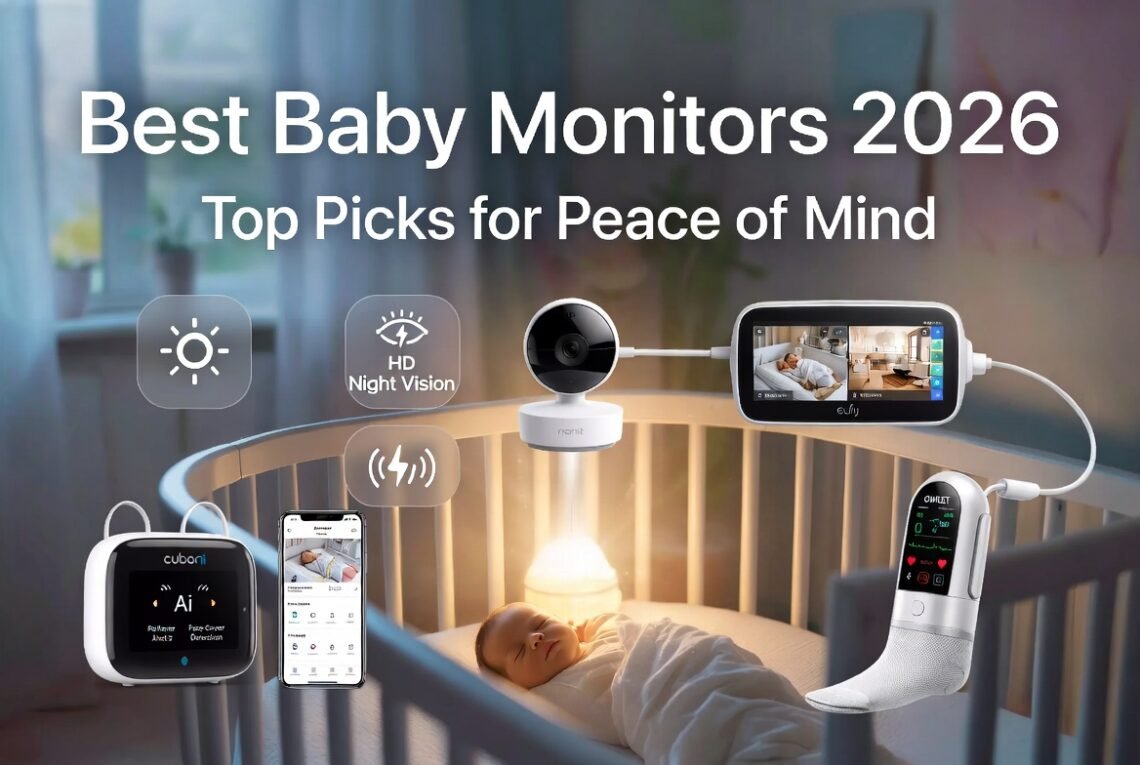
Quick picks ahead: Nanit Pro (best overall), Owlet Dream Duo 2 (best for health tracking), Infant Optics DXR-8 Pro (best non-WiFi), HelloBaby HB6550 (best budget), Eufy SpaceView (best value video), Babysense MaxView (best for multiples).
What should you look for in a baby monitor?
Before diving into specific picks, it helps to know what features actually matter — and which ones are just nice-sounding marketing fluff.
What video resolution do you actually need?
The short answer: don’t go below 720p, and 1080p is the sweet spot for most families. Consumer Reports notes that resolution ranges from grainy 320p all the way up to full HD 1080p, and while even lower-res models are technically viewable, the extra clarity of HD makes a real difference when you’re squinting at the screen at 3am trying to figure out if your baby kicked off their sleep sack.
Night vision is equally important — look for infrared (IR) night vision that gives a clear black-and-white image in complete darkness. Color night vision sounds appealing in ads, but IR is more accurate and reliable for seeing exactly what’s happening in a dark nursery.
WiFi vs. non-WiFi: which is right for you?
This is the biggest decision you’ll make, and it comes down to your priorities. Sleep of Mind puts it well: WiFi monitors offer remote access from anywhere and higher video resolution, but they rely on your internet connection and can have security implications if not properly set up. Non-WiFi (radio frequency) monitors are more secure by default, easier to use, and don’t require an app — but you can’t check in from outside the house.
A few key extras to also check off your list: two-way audio (so you can soothe baby without going in the room), pan/tilt/zoom control, a temperature sensor, and battery life that actually lasts through a full night. As Babysense points out, a wide field of view of 100 degrees or more lets you see both the crib and the nursery door — worth prioritizing.
The best baby monitors of 2026
Nanit Pro
~$299 · WiFi · Subscription optional ($5/mo for full insights)
The Nanit Pro took Gold at the 2026 Mother&Baby Awards, and it’s easy to see why. It shoots in full 1080p HD with excellent night vision, and its overhead wall-mount design gives you a bird’s-eye view of the entire crib — great for tracking movement and sleep position. The app integrates sleep analytics directly, so you can review wake-ups and nap patterns without keeping a manual log. Setup is quick, the cord tucks neatly into the stand, and the mounting options (wall, floor stand, or furniture mount) mean you don’t have to drill holes if you don’t want to.
The one catch: to unlock historical sleep insights and video storage, you’ll need the Nanit Insights subscription. The monitor still works fully without it — you just lose the data archive. Mommyhood101 called it the best WiFi monitor for smartphone integration after hands-on testing.
Best for: Parents who want detailed sleep data alongside great video quality.
Best for health tracking
Owlet Dream Duo 2
~$399 · WiFi · Subscription for advanced features
If you’re the type of parent who finds peace in data — not anxiety — this is your monitor. The Dream Duo 2 pairs a 1080p camera with Owlet’s famous sock sensor, which tracks heart rate, oxygen levels, movement, and sleep stages right from your baby’s foot. BabyGearLab, which updated their review in March 2026, calls it an impressive “one-and-done” option for families who want comprehensive monitoring in a single device.
The sock is soft, easy to fasten, and doesn’t seem to bother babies during sleep. The alert system is on the quieter side, so heavy sleepers may want to keep their phone volume up. It’s expensive, but if you’re going to buy a video monitor and a wearable tracker separately anyway, bundling them makes sense.
Best for: Parents who want vitals tracking alongside video monitoring — and won’t spiral over the data.
Best non-WiFi
Infant Optics DXR-8 Pro
~$169 · No WiFi · No subscription fees
For parents who don’t want their baby’s video anywhere near the internet, the Infant Optics DXR-8 Pro is the gold standard. TeachToddler, which tested 47 monitors over six months with real families, named it their best overall pick for reliability, video quality, and expandability — noting it consistently delivered without connection issues over years of use.
It supports swappable lenses (standard, wide angle, zoom), which is a genuinely useful feature as your child grows and you rearrange the nursery. No subscription, no accounts to create, no worrying about firmware vulnerabilities. Just solid, dependable monitoring.
Best for: Privacy-conscious parents who want reliable monitoring without apps or subscriptions.
Best budget pick
HelloBaby HB6550
~$50–70 · No WiFi · No subscription
Don’t let the price fool you. The HelloBaby HB6550 offers a 5-inch display, pan/tilt/zoom, a built-in temperature sensor, two-way audio, and soothing lullabies — all without WiFi, without an app, and without a single monthly fee. BabyGearLab calls it the perfect solution for most families: simple enough that grandparents and babysitters can use it without a tutorial, reliable enough that it won’t let you down at 2am. In latency testing, it actually outperformed some WiFi cameras, clocking in at under 250ms of real-world lag.
Best for: Parents who want reliable, no-fuss monitoring at an honest price.
Best value video
Eufy SpaceView
~$160 · No WiFi · No subscription
The Eufy SpaceView sits in a sweet spot: a large 5-inch screen, solid video quality, no WiFi required, and no ongoing subscription costs. It’s consistently recommended for parents who want more screen real estate than the HelloBaby but don’t need (or want) smart features. The Eufy E21 version adds a dual-mode option — flip a switch to enable WiFi and app access, or keep it local. In video sharpness testing by Fathercraft, it ranked as the crispest monitor tested across all price tiers, with clean night vision to match.
Best for: Parents who want great video quality without paying for features they’ll never use.
Best for multiples
Babysense MaxView
~$180–200 · No WiFi · No subscription
If you’ve got twins, siblings in separate rooms, or you want to watch both the nursery and a playroom simultaneously, the MaxView delivers split-screen without the WiFi risk. It pairs two cameras with a 5.5-inch 1080p display — the sharpest non-WiFi handheld screen tested in Babysense’s own roundup of 32 models. The 5,000mAh battery lasts up to 30 hours in audio-only mode, and the system supports up to four cameras for future expansion.
Best for: Families monitoring two or more kids who want true split-screen without internet exposure.
Are WiFi baby monitors safe?
Yes — with the right setup. Consumer Reports evaluates monitors specifically for security vulnerabilities, and their top picks are vetted for data practices and network safety. That said, any connected device requires some basic hygiene on your end:
- Use a strong, unique password (8+ characters, mixed characters) — not the default one the monitor ships with
- Enable two-factor authentication if the app supports it
- Keep firmware updated — monthly if the monitor doesn’t auto-update
- Connect the monitor to your router’s guest network to isolate it from your personal devices
Non-WiFi monitors eliminate network exposure entirely, which is why picks like the Infant Optics and HelloBaby remain popular with privacy-minded parents. But a properly secured WiFi monitor is not a meaningful security risk for most households.
Do you need a wearable baby monitor?
Wearable monitors — like the Owlet Dream Sock or Nanit’s Breathing Wear — track heart rate, oxygen saturation, and movement while your baby sleeps. They sound incredibly reassuring, and for some parents they genuinely are. But it’s worth knowing what the experts say before you add one to your registry.
Both the American Academy of Pediatrics and the FDA have noted that these devices haven’t been proven to prevent SIDS, and they haven’t been cleared as medical devices. Consumer Reports advises parents to talk with their pediatrician before using infant health tracking devices. For anxious parents, constantly watching oxygen numbers can actually make sleep harder — not easier.
That said, if you’re the type who genuinely sleeps better knowing the data is there, and you won’t spiral over normal fluctuations, a wearable can be a worthwhile addition. Just go in with clear expectations: it’s a peace-of-mind tool, not a medical monitor.